32080
Thermador Condenser Corrosion, Anastasia Island
Davis Shores, Marsh Creek and Sea Colony sit between the Matanzas River and the Atlantic. Corrosion is what shortens appliance life on a barrier island.
Mon–Fri 8:00am – 6:00pm Sat 9:00am – 4:00pm
St. Augustine, FL · St. Johns County
Independent Thermador service · St. Augustine, FL
cooking
Ranges, rangetops and cooktops, gas and induction. Ignition, heat control and the electronics underneath, measured on a meter before anything is quoted.
Flat $80 diagnostic, credited toward the repair when you approve the work.
Cooking
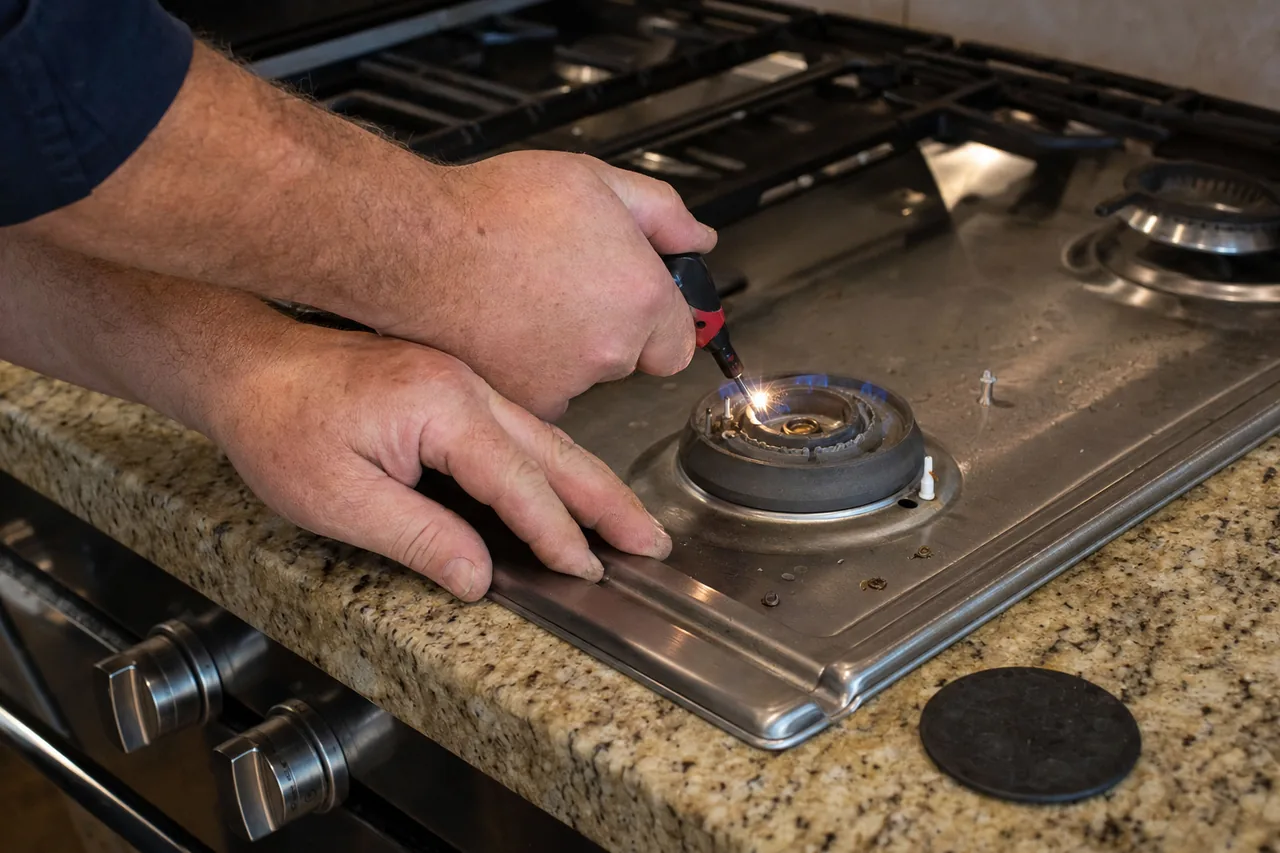
A burner that clicks but will not catch is usually a wet or fouled electrode, not a spark module. The cap comes off first, every time.
What brings us out
Scope of work
The rangetop is the appliance that gets used every day, so it is also the one people learn to read. A burner that has changed its sound, its colour or the way it holds a low flame is telling you something specific, and most of those faults are cheap to fix if they are caught before they take a valve or a control board with them.
Continuous clicking with no light is almost always the spark circuit or the path the spark has to jump. The usual culprits, in the order we check them: a burner cap sitting a few millimetres off its seat after cleaning, a wet electrode that has not dried out since the last spill, a hairline crack in the electrode’s ceramic insulator that lets the spark leak to the chassis, or a spark module that has lost one output while the others still fire.
Thermador’s star-shaped burner heads spread the flame ports further out from the centre than a round head does, which is good for even heat and unforgiving of a cap that is off-centre by a fraction. If one burner lights and the one beside it only clicks, the difference is usually mechanical, not electrical, and it is worth a look before anyone orders a part.
A clean burner burns blue with a defined cone. Yellow tips mean the air-to-gas mixture is wrong: a blocked port, a spider web in the venturi after a summer of the house being shut up, or an orifice sized for the wrong fuel. That last one matters here. Plenty of homes in the county sit outside the natural gas mains and run on propane from a yard tank, and an appliance moved between houses without the correct conversion will never burn right no matter how many times the burner is cleaned.
Simmer is a separate complaint. When a low setting stops holding and starts cycling between a roar and nothing, the fault is usually in the valve or in the calibration of the low-flame stop rather than in the burner itself. We set it by observation with a pan of water on the surface, not by guessing at the knob position, because the number on the bezel is not the number the valve is actually passing.
Induction surfaces fail in ways that have nothing to do with gas. An element that drops out under a pan it used to hold is often a pan detection problem — warped bases lift out of contact as they heat — but it can also be a coil or a filter board that has been running hot.
That last point is local. Induction cooktops pull room air through the chassis to cool the power electronics, and within a mile or two of the Atlantic that air carries salt along with grease. We find corroded connector pins and dust mats on cooling fans in island kitchens far more often than in inland ones, and a fan that is running loudly is worth attention before the board it protects gives up.
On a full range, the oven below shares the door, hinge and gasket problems of any wall oven, plus the heat and grease of the surface above it. Doors that no longer close square lose heat on one side of the cavity, which shows up as a sheet pan that browns unevenly long before anyone suspects the door.
We work from measurement. Spark output, valve function, element and sensor resistance, and a temperature check in the cavity against what the display claims. Gas work is checked for leaks at every joint we open. You get a written estimate before a part is ordered, the flat diagnostic is credited toward the repair when you approve it, and the labor and parts warranties are the same here as on every other appliance we touch.
Completed work, parts and labor together. Most of what we do on this page lands between $190 and $1,090; the $80 visit comes off that once you approve the repair.
| What gets replaced | Parts and labor |
|---|---|
| Igniter, spark module or surface element | $200–$490 |
| Control board or touch panel | $430–$1,090 |
| Door hinge, glass or seal | $190–$630 |
| Bake or broil element | $200–$570 |
Before any of that
$80
Flat $80 diagnostic covering the visit and the full diagnostic sequence, credited toward the repair once you approve the work.
You get a written estimate before any part is ordered or any labor is billed.
Where this comes up
32080
Davis Shores, Marsh Creek and Sea Colony sit between the Matanzas River and the Atlantic. Corrosion is what shortens appliance life on a barrier island.
32095
Palencia kitchens went in with the houses, so most of what we open is somewhere between its first and second decade. That decides what fails and what it costs.
32084
In the 32084 ZIP the coast sets the agenda: corroded condenser fins, seized hinges, and older kitchens that were never wired for what is now in them.
4.5
out of 5, across 60 customer reviews. Each one is a single visit, in the words of the person whose kitchen it was.
One zone of the induction hob lost power under load and came back cold. He found a dry solder joint on the power board, reflowed it and retested under a full pan of water. It has not faltered once since.
Georgina H.
Grease had worked into the spark switches and every knob was setting off every igniter. He stripped the fascia, cleaned each switch and refitted it. He also showed me how to clean around them without soaking the panel.
Fabian W.
Two rear burners lit slowly and smelled wrong doing it. He checked the orifices, found them partly blocked by a spider nest in the burner tube and cleared both out. Lighting is instant again and the smell has gone.
Bernadette L.